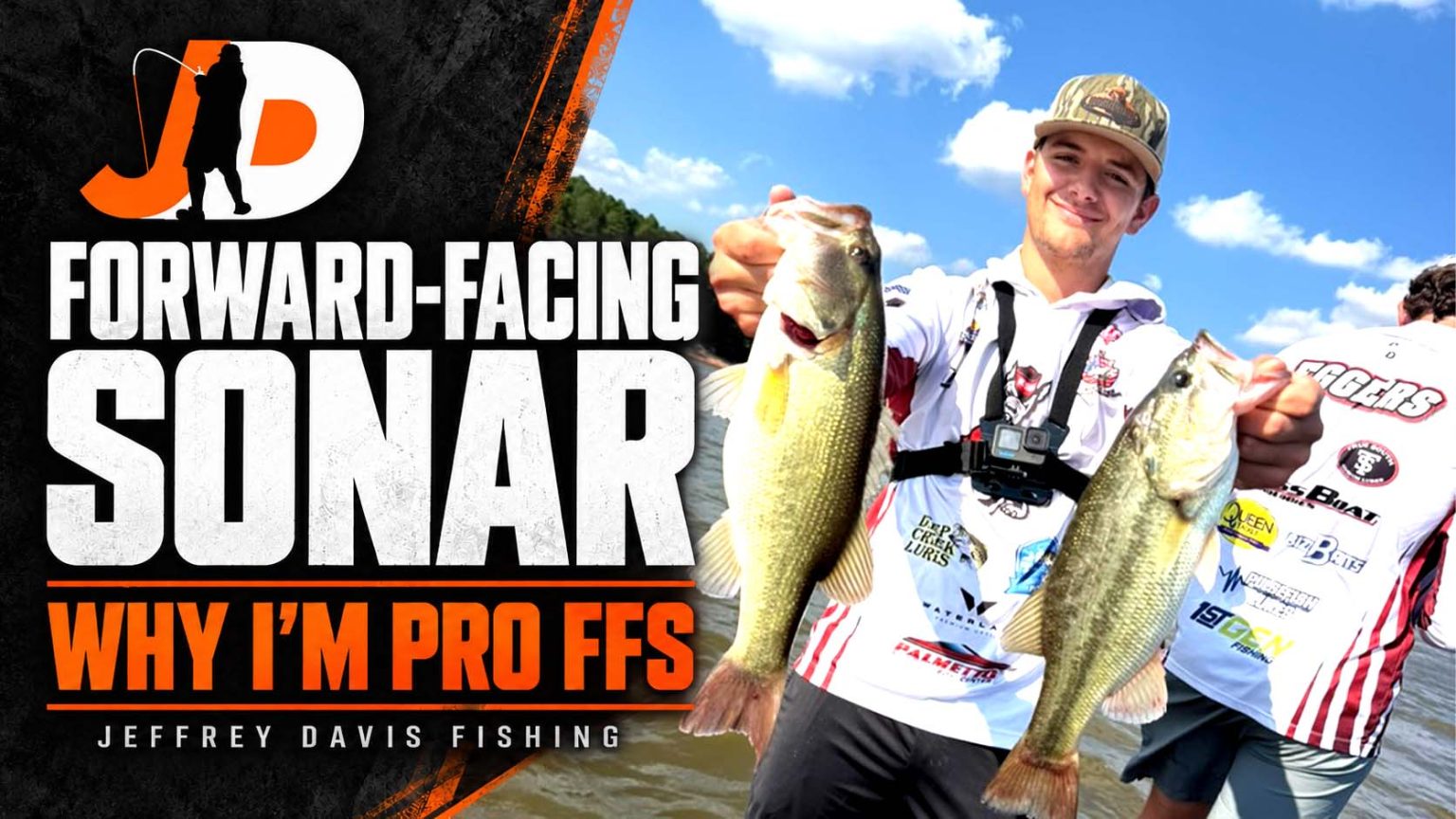
I have been fishing recreational and competitively since 2013. Never before have I seen something so controversial in the fishing industry. The idea of using or not using forward facing sonar is splitting anglers, fans, tournament directors, outdoor companies, and the entire industry in half. So I feel compelled to give my thoughts and opinions on technology. Spoiler alert…. I’m very Pro FFS.
I’m going to be blunt… Forward facing sonar belongs in tournament bass fishing, and I’m not shy about saying it. The debate over FFS is real. I fish tournaments, I own and operate the NC Bass Challenge Team Bass Tournament Trail, I guide for bass on Falls Lake, Kerr Lake and Lake Gaston in North Carolina. I’m also the coach of the NC State University BassPack. And for all of those things… I rely on Garmin Live Scope, and I love it. I use it every time I’m out on the water. I use it to help my guide clients catch fish. I use it to break down a fishery. I use it to dissect habitat. I use it to catch big bass.
Where FFS tournament rules stand in 2026 and 2027
The big trails have not banned FFS outright, with one exception. Instead, they are limiting it by event, by time block, or by equipment. But this ban may be getting some push back going into 2027.
| Tournament Circuit | Current FFS rule |
|---|---|
| Bassmaster Elite Series | Live sonar allowed at 5 of 9 events, picked by coin flip. |
| MLF Bass Pro Tour | FFS and 360 allowed in one of three periods each day, declared in advance; two transducers max. |
| MLF Tackle Warehouse Pro Circuit, Toyota Series, Phoenix BFL | 2026 Rules: One continuous 3-hour FFS window per competition day. |
| MLF high school regular season | FFS not permitted. |
| NPFL | FFS banned in practice and competition since 2025. |
Even the organizations restricting FFS know anglers and fans want to see it and use it. Five of nine Elite events still allow it, and the 2027 Classic will be fished with it. In fact, after just 1 season of Major League Fishing putting a 3 hour time limit for FFS use in BFL’s, they’ve completely back-tracked and are now allowing it full time in 2027 with the new team format.
The MLF Toyota Series is also back tracking on the 3 hour rule. In 2027 it is now completely allowed for select events during all 3 days of competition. The feedback from anglers was loud and clear, they/we wanted the full use of FFS. The participation numbers were staggering low for BFL and Toyota Series tournaments in 2026. They clearly had a participation problem. This backtrack of the current rule clearly shows MLF received enough feedback from anglers that a change to the tournament rules was required… so a change was made.
That change was made to the delight of anglers as the new rules are receiving overwhelming positive feedback online and on social media platforms.
The case for forward-facing sonar in tournaments
My position is simple: FFS is a skill, it grows the sport, and it belongs in competition. Here’s why.
FFS is a skill, not a cheat code
Seeing a fish on the screen is not the same as catching it. You still have to position the boat, pick the right bait, make the cast, control the lure at the right depth, read how the fish reacts, and time the hookset perfectly. Anyone who has watched a good scoper work a school knows that is a learned craft. This explains why so many anglers struggle with it. It’s not as simple as seeing the fish and then catching them.
Every big leap in fishing electronics was called cheating
Flashers, graphs, GPS, side imaging and shallow-water anchors were all controversial once. Today nobody calls a waypoint unfair. FFS is the next step in that same line, and the sport has always absorbed new tools and gotten better for it.
It grows the sport and levels the field for newer anglers
As a guide, I spend most of my days with novice anglers. Live sonar shortens the learning curve more than anything I’ve seen. A newer angler can see where fish are, how they relate to cover, and how they react to a bait in real time. As a college coach, I see the same thing with the NC State BassPack. Young anglers who grew up with LiveScope are not “less skilled.” They learned a different, very demanding skill set. Shutting that out tells the next generation their way of fishing doesn’t count.
Restrictions are hard to enforce at the local level
The top circuits enforce their FFS limits with officials, lock boxes and onboard cameras. A local or regional trail doesn’t have that. As someone who runs a tournament trail, I can tell you that rules you can’t enforce fairly create more problems than they solve.
Anglers have already made the investment
A single Garmin LiveScope 2 transducer sells for about $2,000, before the display. Tournament anglers rigged their boats in good faith under the rules. Taking FFS away strands that investment, especially for weekend competitors on a budget.
What the critics get right (and where I disagree)
The debate is real because the other side has real arguments. Here are the strongest ones, and my take on each.
“FFS puts too much pressure on fish.” Some veteran pros argue that seeing and chasing every fish adds pressure, and that the long-term effect is unknown. That’s a fair concern. My answer is better fisheries research and good fish care, not banning a tool we’ve barely studied.
“It shrinks the skill set to one technique.” Many Elite pros voted for limits through the Angler Board of Professionals. But the split schedule now rewards anglers who can do both, and the young “scopers” are getting their chance to prove they can. The tool did not erase the fundamentals.
“Fans like the no-sonar events.” B.A.S.S. reported that its no-live-sonar event on Lake Guntersville was the most-viewed regular-season Elite event of 2026. I take that seriously. To me it shows fans enjoy variety, and a 50/50 schedule still puts FFS in front of them at most events.
“It’s expensive.” It is. So were the boat, the motor, the graphs and the trolling motor. Cost has always been part of competitive fishing, and a ban doesn’t refund anyone’s investment. I respect anglers who want limits. I just believe the sport is better when we teach and showcase FFS instead of fencing it off.
My bottom line
The debate over FFS is real, and it isn’t going away. But forward-facing sonar is not the enemy of bass fishing. It’s the newest chapter in a sport that has always rewarded anglers who learn new tools and master them. I’ll keep running Garmin LiveScope, teaching it to my clients and college anglers, and making the case for it in tournaments. If you want to see how live sonar really works on the water, come fish with me.
Book a guided bass trip with me and see just how fun and amazing FFS is to use.